Showing posts with label spies. Show all posts

Wednesday, May 3, 2023

QUICK SHOTS: Evan Tanner #6: Here Comes a Hero by Lawrence Block

Lawrence Block is one of the those writers that can't write a bad book. Between his Scudder books, his Burglar books and everything in between his literary output has long been a staple of my reading diet. Often lost in the shuffle is his short-run series about Evan Tanner, the thief who couldn't sleep and sometimes spy and just about everything else. He's got a lot of times on his hand, you see. In the scheme of Block's career these madcap adventures are bit of a sidenote simply sliding into obscurity because of the vastness and quality of his later work. Similarly afflicted is his equally as wonderful Chip Harrison series.

After shrapnel destroyed the sleep center of his brain Evan took to joining oddball organizations, learning languages, reading and getting into trouble. All those things make for a good spy, only Evan isn't actually any sort of secret agent. But his boss at the super-duper secret no-name espionage agency doesn't know that. Evan recounts his adventures in the same light, easy going-style that Block also used for his later Bernie Rhodenbarr mysteries. He also ghost-writes term papers...for a price.

In Here Comes a Hero (also known as Tanner's Virgin) Evan falls for the titular virgin (depending on edition) before she decides to move on and ends up being sold into slavery. Guess who has to go save her? Evan's on the trail after a call from the virgin's mother and quickly finds himself London and proving he's fairly hard-boiled despite his nearly-comic narration. After that it's a travelogue quest full of colorful slave-traders, '55 Russian Chevrolets, Russian hit squads, brothels, and the prerequisite gun fights and fist fights. Part of the fun of a Tanner book is that Block is sure to write a lot of the parts that are easily glossed over in other books i.e. sleeping. No sleeping during travel, no sleeping in the bed of night when the rest of the characters are, and Evan is stuck reading some bad plays in a actors flat or feigning sleep on a ship full of Russian spies. 

It's interesting to think that these were on the spinner racks next to Gold Medal's other spy novels staring the likes of Matt Helm and Sam Durell, they're so similar yet light years apart. This is a re-read but it's one of those that I had read so long ago that I barely remembered any bits from it, it's nice for these series that I really love to be able to eventually reread them almost fresh again. Block has been one of my favorite writers forever and every book of his I read reproofs it. I also have strong affection for these Jove editions of the Tanner books as they are obviously apeing the Berekly/Charter edition of the James Bond books that were out at the same time and were some of my first Bond reads. Ah, nostalgia.

Monday, February 7, 2022

QUICK SHOTS: "Dead Man's Tale" by Ellery (Stephen Marlowe) Queen

Ellery Queen is a big-time mystery name that I don't have much experience with. I'm not much on fair-play golden-age mysteries outside of B-movies of the era. Because of that I've pretty much ignored the Queen books in the used books stores of past and present. Well, the further you walk down that dark alley the weirder you get. I'm still not interested is golden-age mystery but when I started to figure out that sometimes Queen wasn't really Queen. I guess he was never Queen at all just usually two guys named Frederic Dannay and Manfred Bennington Lee. Anyway, sometimes he wasn't those two guys he was a who's-who of 50's crime/mystery writers. Names like Talmage Powell, Richard Deming, Gil Brewer, Charles W. Runyon, Henry Kane, Fletcher Flora and Stephen Marlowe, among others. After I figured this out, I started to get interested quick.

Stephen Marlowe is a well-known name in the Gold Medal circles for his Chester Drum novels of high-flying-private-eye-espionage action. He was never a "star" like a Donald Hamilton or a Richard S. Prather but the Chet Drum books lasted from 1955 to 1968 and are uniformly well-written action/thrillers that take Drum and his .357 all over the world hunting baddies not to mention the prerequisite pretty ladies that are involved. As Jason Ridgway he wrote a four-book series of wild mysteries for the "Ripley's Believe it or Not!" organization about an investigator for Ripley's hunting oddities around the world and falling into crime. He wrote a lot more stuff, some science fiction, some straight thrillers, some bids for a "big best seller" and finished his long career in the 90's writing a well-regarded trilogy about Christopher Columbus. Not bad at all.

"Dead Man's Tale" is a cold-war era mystery that bounds from the rubble of W.W.II to tell a tale of the quest two brothers take to finds a mysterious Czech named Milo Hacha. Steve Longacre is the right-hand man to a recently bumped off "political fixer" with a dark past who gets blackmailed by the fixer's wife to go make sure Milo Hacha is really dead since the fixer left him his whole estate and if Hacha is croaked it's hers. Along for the ride is Andy, Steve's fresh-faced college brother who tags along. Stylistically is very similar to Marlowe's other works. It has a travelogue feel as Steve and Andy trek across Europe and it's steeped in the Cold War-vibe of the Drums. But it has a more "literary" feel then a lot of the other novels I've read by him. It bounces from third person to first person-snippets of Andy's Diary, which is a bit jarring. But you get some dangerous border-crossings, Luger pistols, iron curtains, political assassinations, secret police, mob bosses, jilted wives, black-marketeers and blind-old killers. 

When it comes down to it, this is sort of a minor-warmed-over "Third Man" and Milo Hacha is a second-rate Harry Lime. The book is simply too stuffed with minor characters that Marlowe spends too much time with. It either needed to be a 200 page + novel or edited and focused. Add that with the shifting POV which is something that I have never really warmed up too. I wonder what ghost-writing for Ellery Queen was like this is a tamer and more serious Marlowe. Marlowe was a pro so he might have just been writing for a specific market. The only other non-Queen that I have read was "The Black Heart Murders" the 2nd book in the Troubleshooter series about Mike McCall which was written by Richard Deming. It was a straight detective novel in the medium-boiled school, which to be honest is a lot like a Richard Deming novel. So, maybe it all came down to editorial pressure or maybe it was just Marlowe doing a dry run for his later more serious-minded novels. I haven't given up on the other ghosted-Queen books, I'm especially a sucker for these doubles that got put out. Can't beat two-for-one. This is probably my least favorite book I've ever reviewed. Only Marlowe's quality writing got me to finish. The reason there's no bad reviews on my blog is simply this: if a book doesn't work for me, I set it aside. I never muscle through a bad book. Life's too short for that. This isn't a bad novel, just a mediocre one from a helluva writer.   

Thursday, November 11, 2021

QUICK SHOTS: The Backup Men by Ross Thomas

Ross Thomas could really write the hell out of a book. He seemed to do it with ease. The natural banter between characters, the natural banter between himself and the reader all pours out on the page like a aged scotch neat. He's a writer's author. He never quite made it super big but instead carving himself a nice career with cloak and dagger books that were like no other. He started late in life which seems to have been a colorful life and after two weeks in his 40's he had a book down that won an Edgar. Then BANG he had a career. I personally probably gleaned a lot of my views on what a politician is based on the descriptions of the folk who hang out at Mac's Place in D.C. in Thomas's books. As I got older I haven't found that Thomas's opinions of senators, congressmen, government types or bartenders were wrong. There's not really "nice people" in his books, but you don't mind spending time with them, the way it happens sometimes in life too.

The older I get the more open to re-reading. I first read this during a snowy winter in my 20's. I remember it distinctly as I read a chunk of it in a cold 1963 Ford Fairlane that I had just driven off the road after having a run-in with a patch of ice while waiting for a tow. I guided the car through a barbed wire fence and between two trees. It was a fancy bit of sliding. It was nice company. "The Backup Men" is the third book about "Mac" McCorkle and Michael Padillo, a barman and a deadly (sometimes) ex-spy. Mac's narration probably pretty close to talking Thomas himself, at least that's the way I like to think of it. Together they own the aforementioned Mac's Place formerly in Bonn, Germany but in D.C. in this book. Padillo is around sometimes, sometimes he's off doing the spy-bit. Mac runs the bar and tells us their stories. Open on of their books and skullduggery always ensues. In this one they are roped into being body guards to a new King and his adviser as they cross the U.S. to sign some important papers about the fate of the new King's oil rich country. Along the way they get involved with the personal revenge of Wanda, sister of the dead a-team, fend off professional killers, drink copious amounts of booze, fall into and setup up various traps, meet nice-old society ladies and exchange wise-cracks. It's a book full of old friends even if this is the first time you met them. You read a Thomas not for the plot (though those are always good too) you read them to enjoy a drink and dodge a few bullets in capable hands. 

Thomas is on my Mt. Rushmore of favorite authors. He writes with a thick brush of sarcasm and wit but never sacrifices the intrigue and action. He's best when he gets to write about a duo having wild adventures like Mac and Padillo or Artie Wu and Quincy Durant but his "professional go-between" Phillip St. Ives novels (as by Oliver Bleeck) are also uniformly good, if a little slight. St. Ives got a Charlie Bronson movie made out of one of them too. His novel "Briarpatch" was just made into a TV series, staring Rosario Dawson but even now Ross Thomas is vastly underrated and bordering on being a forgotten writer. I keep him next my Donald E. Westlake novels on the shelf, so you know, close to the heart. 

Tuesday, October 12, 2021

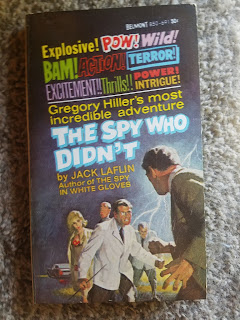
QUICK SHOTS: "The Spy Who Didn't" by Jack Laflin

See Steve Holland's ear?

I have pretty much accumulated every book Jack Laflin ever wrote without really trying. That's the way book collecting works sometimes. I found some a the local book pusher for cheap, others picked up in lots on eBay, and one in a truck stop. Not that it's a tall order he only wrote 10-ish novels. Belmont Tower pushed him in the late 60's with high-camp style covers that we obviously a cash-in for the "Batman" tv series. The covers are great and star everyone's favorite male model Steve Holland as the super-duper CIA agent Gregory Hiller. But what about what's under dem covers?

Gregory Hiller is a CIA agent, a Russian CIA agent. A defector turned "No. 1 troubleshooter," which is what I'm going to put on my business cards. Actually he came to America with a little plastic surgery (to look like Steve Holland, who wouldn't?) to impersonate a top man. But he found out he liked the good 'ol U.S. of A and switched sides. It's a nice, interesting backstory that sets him apart from the crowd of Bond-impersonators of the 60's paperback world. Well, so Old Greg is on vacation when he helps a old-man on the run and ends up in a insane asylum being tortured by a Nazi and a Nazi She-Devil. After an escape and a detour to Mexico Greg uncovers dastardly Nazi plots involving sunken Spanish gold, bombs, Man Mountains, the beautiful lady kind of Israeli agents, fights the Ku Klux Klan plus Nazi's in a giant cave AND kills a very notable bad-guy.

Laflin wrote a fun book. More than anything it reminded me of something out of an "Ace G-Man" pulp. Greg Hiller, despite his Russian origins, just screams AMERICA! He works with the FBI and local cops and just comes across less of a International Man of Mystery and more of a working stiff government man with a blazing walnut-stocked .357 Magnum. It makes you wonder what pulp magazines Laflin read a kid. All-in-all it's a romp of a novel, I'm sure Laflin's tongue was at least slightly in his cheek, so the pop-art covers actually fit the contents of the book. How's that for judging books by their covers? 

Laflin wrote the five book Gregory Hiller series, a YA book about football, a 70's horror/disaster novel about killer bees, finally a entry in the The Adjusters series (coincidently the only on that series published under the author's real name) and that was it. Except maybe a hardcover book in 1991 called "Serpent in Paradise" but I haven't figured out if it was the same Laflin. Fill me in if you know the unclassified truth! I'm going to try his Adjusters novel next to see if he molded himself in line for that series or just wrote a Greg Hiller book under a different guise. 

Sunday, September 26, 2021

Michael Avallone's The Man from Avon and Other Book Selling Men of Action Plus Bettie Page


I had a fever when I picked up "The Man from Avon," man. I felt like a heap of crap, I needed me a pick me up and in that fevered state I figured I was in the perfect mindset to visit the "Nooniverse." Okay, "The Man from Avon" isn't an Ed Noon story but the wild antics and undisputable laws of the Nooniverse apply to the entirety of Michael Avallone's work. So, just go with me here, okay? Plunge into the weird. 

Ironically it was his novelization to "Cannonball Run" I read first without knowing who the author was, but that's another story of misspent muscle-car driving youth. Then I knew his name before I had knowingly read one of his books though the seemingly always snarky "online critics" of his work. Their words made it sound like his writing was bad, but hell, it sounded SO good. After that I actually discovered who/what a Avallone book actually was via a four-pack of dollar used books one day at my local dealer. Two Ed Noon's, his Man from U.N.C.L.E. and finally "The Man from Avon." I was hooked. The years past and I discovered Avallone wrote all the stuff I like, hard-boiled private eyes, Men's Adventure vigilantes, super spy-fi spies, tawdry little noir-types, novelizations, and most of all PULP! 

It had been too long between readings of Avon for me to remember much about it. I just remember finding it to be a bunch of fun bounded together between paper. Jerry McKnight is the top salesman for Avon books which works as the perfect cover for his actual job as the Government's top super-duper secret agent hunting down them pesky U.F.O.'s. Jerry is a little more idolized then my old buddy Ed Noon. Noon is a bit of a regular schlub thrown into the crazy, mixed-up action. Larry is Steve Holland with a case full of books. After a very real U.F.O. is seen by a sexy librarian in Old Bridge, New Hampshire Larry is parachuted down with different sexy lady with his Avon case in tow to investigate. The book actually owes a lot to the Operator No. 5 pulp tales, stalwart hero against a seemingly fantastic enemy. It boils into a cross-country chase full of strangely electrocuted victims, U.F.O. chases, spy-fi weaponry, beautiful virgins, characters named Gil Kane, odd city-wide blackouts, and valuable information about Avon book's products. Seriously, if you dig old paperbacks (who doesn't?) this part of the book is worth the price of admission. Clues hidden in rejected of Robin Moore's "The Green Berets," discussions of John Creasey's The Baron, spy books and even John D. MacDonald. Not to mention a little about how the book selling business actually worked back then. It's only let down by a slightly rushed ending, but still a more than worthy entry into Avallone's library.  

You'd think this would be the only example of spy/bookseller in the paperback world, but a year later in 1968 Sphere book across the pond put out "The Man from Sphere" by John Gaunt. This is a bit more traditional (from perusing) Bond-like spy tale about a hero named Galahad Brown. I'll report back on this one. But here's where it gets even wilder, there's another HIDDEN (sorta) Larry McKnight adventure.

"A Rep for Murder" stars Avon salesman Larry McKnight Jr. on the trail of a missing (naturally beautiful) romance novelist and running from a murder rap. Larry Jr. isn't Steve Holland, he's a bumbler trying to save his skin, job and trying not to dishonor the McKnight name. This book was written as a promotional "not for sale" item for Avon's 50 year anniversary it appears on some bibliographies of Avallone, but not all. The book is clearly a work of Avallone's its wild, wacky that barrels forward at break-neck speed and its full of wonderful old mystery clichés. Avallone seemed to have a lot of fun writing it. Plus there's tons of references to Lawrence Block's Matthew Scudder, Ed McBain's 87th Precinct and other great Avon titles. It's a hoot, very much like Avallone writing on of those 40's mystery B-Movies.

Want more? Larry McKnight shows up again! This time in Michael's son David Avallone's work on the Bettie Page comic book put out by Dynamite. In fairness, I received this graphic novel from David Avallone himself, not to review but as a thank you for sending him a harder to find Ed Noon for eBook transfer. And I'm very happy I did, Vol. 1 is a blast! McKnight is Bettie Page's boss as she works for the government as a spy hunting down wild villain's, filming a sci-fi movie, clashing with cults, and basically being a wry comic book hero which is enough for me. It's a rollicking good time and it's nice that old McKnight is still kicking around. Also check out David's work on the Elvira comic, its just as good and enjoyable. I need to catch up with more of his work as he's written both The Shadow, Zorro AND Doc Savage! Too cool. Though a Ed Noon comic book would be something...*cough* *cough*

Can you tell I like Michael Avallone? He was a one-of-a-kind writer and that's something commendable, not many authors have a voice strong enough to to be instantly recognizable. I like one-of-a-kind writers, just like I like one-of-a-kind people, they kind of folk you can yak at for hours and hours. Reading an Avallone is sorta like listening to a buddy spin a yarn at you. Do yourself a favor pick up a Avallone and have a good time. And don't trust just any online reviewer...

Oh, wait...

Thursday, September 23, 2021

QUICK SHOTS: The Man from WAR #2: Mission: Tank Force by Michael Kurland


An early morning cat induced wake-up call and a pending COVID test gave me plenty of time stretched out on the couch on a crisp fall morning with no pressing engagements. Although suddenly from a shelf in my office a book started yelling at me. A few years ago I read a book called "Mission: Third Force" and it knocked my socks off. That is if I was wearing socks, usually I don't. Anyway, Michael Kurland wrote that book as the start of a three book (should have been longer) series about Peter Carthage a, uh, troubleshooter or agent for Weapons Analysis and Research, INC. The second book was calling me this morning. I've only resisted this long in reading it by shear will power because now there's only one more W.A.R. book to enjoy. I read the book cover-to-cover, so I suppose I did have a pressing engagement. 

Michael Kurland has written a fair amount books, a lot of science fiction and novels about Sherlock Holmes arch-rival Moriarty among stand-alone's. Stuck in the late-60's boom of spy-fi novels is this three book series that is very different from the sea of Bond-clones. Peter Carthage works for W.A.R. which is a company that provides weapons of war, training and plans for their clients. Also will fight them for the right price. Say, like in "Mission: Tank Force" you are Sheik in a country that just struck oil and your British protection is running out and there's vultures circling, you can call W.A.R. and they can help you out. Carthage and his comrades got to such a place to teach a fresh country the art of tank warfare and battle opposing force as radically different as a former Nazi and a supposedly the supposedly 900-year old Hasan Sabbah and his drug-induced army of killers. The action is tight and well throughout but it's the fun, devil-may-care employees of W.A.R. that are the real draw. Their banter and friendship is palpable and the dialog is witty and crisp. Along the way, there's tank-fights, drugging's, ambushes, trick shooting snakes, and beautiful women hitch-hiking in the desert. 

Kurland writing Moriarty novels is a easy stretch, the W.A.R. books have a old-fashion quality of sweeping adventure but bring to mind examples like Alexandre Dumas to Manning Coles' Tommy Hambledon and Rex Stout's Nero Wolfe mixed the with adventurous spirit of Leslie Charteris's early Saint novels. But more importantly they are just incredibly fun, well-written examples of different type of espionage fiction. This a series that could have last ten more books or could easily be picked up today and continued. The first two seem to available cheap as eBooks and paperbacks reprints. The originals sport of great paperback artwork and can be found fairly cheap too, so either way just GO OUT AND BUY 'EM!

Wednesday, June 2, 2021

Operation Hang Ten #3: Too Mini Murders by Patrick (George Snyder) Morgan


The Operation Hang Ten books are one of those high-priced series that I'm sure most people have bought just for the covers or the novelty. They're nice covers and it's also got a surfing angle that appeals to the surfers out there, further adding to the scarcity. But it's a shame as they're pretty good. They were also a Lyle Kenyon Engle joint, a paperback "packager" who came up with Nick Carter's Killmaster make-over as well as Dracula Returns, The Baroness, Chopper Cop etc. etc. Engle hired writer George Snyder to flesh out what I assume was some sort of "Mod Squad" riff about a surfer/spy that was at least sort of based on Snyder's first novel "Surfside Sex" from Neva books, which is desperately want to own/read. It lasted for ten books, which is decent run. Hell Chopper Cop only got 3.

George Snyder wrote a lot of books, he provided seven Nick Carter Killmaster adventures, contributed for  two for the short-lived Grant Fowler spy novels for Award books, a stand-alone Manson cash-in "The Hippy Cult Murders" as Ray Stanley and a then later in life he had three series running with characters named Ray Rumble, Logan Sand and Mac Tuff. The Bay Rumble books seem like a modern riff on the Operation Hang Ten books, I have the first but haven't tackled it yet. I'm a fan, he kind of gets a bad rap on the internet which mostly stems (I think) from the price of the Hang Ten books and what a readers expectations are. Cause he's the rub: The adventures of Bill Cartwright agent of Operation Hang Ten aren't really the swinging spy novels they are packaged to be. No, they are hard-boiled detective yarns. So, if you spend a lot of money for a musty old spy paperback and get very little spying, you might be disappointed. Go into them thinking of them as Hi-Tech Detective novels and you'll have a good time. 

Bill Cartwright is a young "anti-establishment" type-via in a Frank Sinatra sorta way. He's a millionaire  because of the accidental death of his parents who spent his inheritance wisely on a Hemi-powered Woody station wagon and a swingers trailer complete with a "computer" that does everything from making ample amounts of scotch and sodas to watching TV. Also on a small custom built .22 Magnum semi-automatic pistol which he keeps nestled in the small of his back when he's (as he puts it) "manhunting." With all this cool stuff he gets set-up as a private eye by Operation Hang Ten a vague crime-fighting organization that's basically the light beer version of U.N.C.L.E. He's also kinda an arrogant jerk with a MAJOR eye for the ladies. He's a weird mix of the old-school version of tough guys and a modern (well, late 60's) "cool dude." But his young age does give the books a breath of fresh air and a different tone from the majority of the Men's Adventure of the time. He can talk hot rods, surfing, and other "youth" activities. I do think the name "Bill Cartwright" doesn't scream secret agent/spy, more like middle-aged rancher. It probably would have been cooler to switch the characters name and the pseudonym Patrick Morgan. At least you'd have a Morgan/pirate connection that would have tied into the surfing/ocean theme. Maybe its just because both my dad's and father-in-law is named Bill is why is a little hard to swallow.

In the third adventure "Too Mini Murders" Bill has to figure out why the pretty daughters of TOP GOVERNMENT MEN are dying. Psst. It's because of secrets. Bill gets tangled up with a few women, battles a Red China agent who acts more like a mob boss and his goons who act exactly like goons. There's some drag-racing, killing with a spear-gun (but not how you think) fights, shootings, grizzly murders and a lot of women getting beat-up, but not by Bill at least but it's a bit excessive. Bill goes around pissing off the cops and "the man," and bitching about the conforming culture that he's bucking against. It's a solid, tight little crime adventure novel, nothing fancy but it goes through the motions in a pleasant way, then rockets into a nice action-packed finale where grenades, hot rods, submarine sabotage and cliff-side crashes all play a part. 

I do have a question to yell out into the vastness of the internet. According the George Snyder himself he was only responsible for seven out of the ten Hang Ten novels:

1. "Hang Dead Hawaiian Style"

2. "Too Mini Murders"

3. "Deadly Group Down Under" 

4. "The Cute and Deadly Surf Twins" 

5. "Scarlet Surf at Makaha" 

7. "The Girl in the Telltale Bikini" 

8. "Beach Queen Blowout"

Which leaves these three unaccounted for:

6. "Topless Dancer Hangup"

9. "Death Car Surfside"

10. "Freaked Out Strangler"

Now, the book that got me hooked on the series was "Death Car Surfside," a non-Snyder penned on, it's been a while I don't really remember a striking difference between the ones that Snyder wrote and "Death Car Surfside," so I wonder who really wrote them. I doubt that Snyder wouldn't fess up to writing all of them if he actually did, but whoever wrote them must have read some of the Snyder's work. So, big mystery. Anyone have any leads? Drop me a line if you do. Inquiring minds (me) want to know. 

Anywho, the Operation Hang Ten books rank highly in my favorite Men's Adventure series list. Their a lot of fun non-sense in the best sense. They feel like novelizations for a favorite old TV show...wait....hold on....go to Google and search "Christopher Stone Operation Hang Ten" and marvel at some pictures. ABC commissioned a 30-minute pilot in 1973 (the same year the book series ended) and it looks pretty good. "Star Trek" vets Gene Coon and Herb Solow were behind the scenes and Stone looks like the guy on the paperback covers. From the pictures it looks like they swapped the Woody and camper for a groovy RV and the vague hints of plot gleaned from here and there makes it seem like Bill would have been more in the "undercover cop" variety. Still I'd love to see it, so few movies or TV were pulled from the paperback-racks of the era, it'd be interesting to see how it fared. Back to the books, if you find one snap it up but maybe don't pay a premium price cause if you're patient you can find them at a decent price, a handful of mine came from different eBay lots and don't be surprised to find water damage. Damn surfers. 

Thursday, March 18, 2021

Earl Drake #5: Operation Breakthrough by Dan J. Marlowe


Dan J. Marlowe is correctly regarded as paperback royalty.  "The Name of the Game is Death" and "One Endless Hour" are stone cold classics (they work best as one bigger-novel) that are hard touch. In them we are introduced to Earl Drake (under a different name) a hard-case criminal who gives Richard Stark's Parker a run for his money. To top it off Marlowe's got a run in the 60's for Gold Medal with a great string of standalone hardboiled work that are nearly all great. Marlowe's real-life story is a paperback novel too full of amnesia, spanking women, local politics, bank robbers, death and drink. I'm not going to get into that too much, as there's much better places that delve into Marlowe's world. What I find interesting is that Marlowe seemed to work with a co-author a lot of the time. Apparently credited co-author on "The Raven is a Blood Red Bird" William C. Odell ( a Colonel in the U.S. Airforce) worked with him on the early Drake books at least, as his entry on the U.S. Naval Institute website credits him as wining a Edgar award that was surely the award the Drake novel "Flashpoint" won. Some online sources cite Fletcher Flora as the co-author to the stand-alone "Vengeance Man" as well. Then there's his noted working with convicted bank robber-turned-writer Al Nussbaum. I get the vibe that Marlowe played things fast and loose in life. I need to track down Charles Kelly's "Gunshots in Another Room: The Forgotten Life of Dan J. Marlowe" and maybe all my questions will be answered.  

So, maybe Fawcett Gold Medal wanted another spy series to go with the adventures of their other series espionage characters and for some reason thought the cold-blood bank robber Chet Arnold, er, Earl Drake would be a good fit. Or maybe Marlowe just wanted to write about spies as he had done before in some of his stand-alone work and wanted to ride the wave of the good vibes from "The Name of the Game is Death." Who knows. Either way Drake became a freelance spy working under a shadowy Government man named Karl Erikson. This era of the Drake books is often kinda dismissed in comparison to his early work which is a shame. The first Marlowe book I read was one of the last Drake novels and it certainly turned me onto Marlowe's writing. The 70's were a weird time for Gold Medal, the emphasis had definitely shifted from standalone's to series work, probably trying to get all that "Executioner" money. There were ongoing series entries in stable series like Matt Helm, Sam Durrell and Joe Gall, plus upstart series like Daniel Da Cruz's Jock Sargent books. I won't even get into the "The Godfather" knockoffs they stuffed the spinner racks with. So, where does Earl Drake land? For my money he's the best Gold Medal spy of the 70's. Sure they're not up there with Marlowe's earlier glory but they are certainly strong works of Men's Adventure. 

"Operation Breakthrough" starts off with a slam-bang heist, barrels through a "man on the run" story, then spy shenanigan's to a break out yarn. Earl Drake is a slick lead character with a nice man-of-a-thousand-faces-gimmick. He's stuiably tough and dangerous with his .38, but he's still a bit of a fish out of water when it comes to spying. This gives him a realistic-vibe, not making him a perfect superman, plus a bitchin' girlfriend names Hazel who's cool under pressure. Marlowe tosses full characters down on the page with ease and short work, all the side-characters seem real or real in a pulp way anyway. There's a continuing story going on here too; you probably need to read the early ones in order; as there's a lot references to past escapades.  If I remember correctly the later books are pretty stand-alone. This is really no-frills top-shelf Men's Adventure. 

Wednesday, March 3, 2021

Quick Shots: Jeff Pride #2: The Duplicate Stiff by Archie O'Neil


Archie O'Neil's Jeff Pride series has been with me for years. It's a simple story: I picked up a couple of cheap books years ago cause of the cover and promptly buried it in a sea of other books. Flash forward to man years later when Paperback Warrior reviewed the first book in the series and it got my off my duff to see what this series is all about. Go over to Paperback Warrior to read about who Archie O'Neill really was and just generally enjoy a much slicker kind of book review of the first book, which I also read, really dug it and then went out (to the internet) and picked up the rest of the books.

I got to admit the reason why I didn't read the series before is that Jeff Pride is a travel agent. It was hump I couldn't traverse. An action-packed mystery solved by a travel agent? Meh. Chalk it up to my prejudice against people who book tickets, I guess. Anyhoo, Jeff Pride is a lot more then simple trip planner, no he's got a background as an "international private investigator" (where do I apply?) for an outfit called Phoenix Security from which he's semi-retired from. He's also got Cherry. Cherry is one of them dames who only exist in the minds of men. She's hot-stuff, witty and wants Pride's bod. BUT she's also his ward (like Batman and Robin) after her father died and asked Pride to watch after her and Pride isn't that creepy. Cherry is a lot of fun and her and Pride have a nice plutonic Nick and Nora vibe of bickering going on. Pride's or O'Neill's sarcastic nature and wit really propel the books past a lot of the standard fare that used to clutter book racks. 

In "The Duplicate Stiff" Pride is in his Paris office and in walks trouble or more accurately trouble (in lady form) bumps into him on the street and causes a stir. She wants Pride to help save her husbands neck with his company after the man he hired had been embezzling. Pride wants nothing to do with but gets dragged into after a murder rap hangs over his head. The plot is nicely standard, like a Taco Bell in a different town. There's a few women for Pride to boink, a seedy/dangerous Private Eye to tangle with, colorful friends, gunfights, car chases and a hardnosed French cop. The Paris scenery and Pride's relationship with Cherry combined with his Pride's glib telling of the facts give the book a nice flare. Jeff Pirde would have been right at home at 60's brand of Gold Medal Paperbacks is Archie O'Neill started writing them sooner. He could have shared drinks with Chet Drum, Constaine and McCall or Shell Scott and fit right in.

Though Shell would have tried to lay the mack on Cherry. 

Wednesday, January 13, 2021

Men's Adventure in Digestable Form

I've been a book slump; what I pick off the shelves just hasn't been hitting me right or maybe the outside world is just keeping too much of my attention. Whenever I get like this I turn to short stories and novellas, punchier works that don't take anytime to devour usually screws my head on straight. When this strikes, I turn to my digest and anthology shelf. I'm a big fan of digests, but they can be a headache to collect, their scarcity and higher prices has made my collection modest, though I buy them whenever I can. I keep dreaming of the find of a full big box of Mike Shayne's, Hitchcock's and Ellery Queen's but it hasn't happened yet, dammit.  Anyway, here's a smattering of short reviews for short works.

"Seven from INTREX" by Michael Avallone in The Saint Mystery Magazine, September 1966

Michael Avallone is one of favorite authors and it had been a while since I dipped into his work. The David Seven series (four stories) all appeared in The Saint Mystery magazine over the course of 2 years. Seven (cool name) is an agent for a independent crime-fighting agency funded by rich people (if only) to work toward Peace, man. 

David Seven himself is a fairly standard secret agent-type, not surprising that Avallone wrote the first Nick Carter, Killmaster AND the first Man from U.N.C.L.E. tie-in novel. This is very much his own version the super-agent. Knowing Avallone's love of the pulps, it wouldn't surprise me if Operator 5 or Secret Agent X helped in the process. Seven's partner Miles Running Bear Farmer, who gets himself in trouble in this story and Seven has to work to get him out. It's a whole lot of fun, short and too the point with all the nice comforting 60's spy-fi tropes that make me feel all warm and fuzzy on the inside. I would have loved it if Avallone wrote expanded Seven's world to novel, but it seems like he was busy enough at the time. Though if David Avallone ever reads this, I'd be first in line with a handful of money for a collection of Michael Avallone's short works.


"A Fox on Broadway" by Gary Phillips in "Crime Square" edited by Robert Randisi

I've long been a fan of Gary Phillips, his Ivan Monk mysteries are some of the most unsung private eye novels of the 90's. Plus his stand-alone novel "The Perpetrators" is a stone-cold action novel classic, one of the most high-octane books I've ever read and one of the few I've read more then once. This story is set in the early 80's and stars Pete Atlas, a Men's Adventure private eye who's just plain cool. Not to mention that it name-drops Angela Harpe, star of the "Dark Angel" series by James Lawrence! (Which got me to spend WAY too much to pick up a entry in the series, god, I'm a sucker)

"A Fox on Broadway" is a hoot! Man, it doesn't seem like Phillips ever revisited the Atlas character and that's a bummer. It reads like a super-condensed paperback novel in one of the "Sweats." The opening grabs you (there's a hat-wearing man in a gorilla suit chasing a naked woman down the street) and then throws you on a wild, tight little escaped involving brain-washing and damned 'ol Nazis. The only problem is that its short, I could have read a lot more about Atlas and his adventures. 


"The Majorcan Assignment" by Bill Pronzini and "The Cinder Man" by Jeffery Wallermann in Mike Shayne Mystery Magazine, October, 1972

It took me a while to realize that I was reading a "Nameless" detective story from Bill Pronzini, it dawned on me about the time I thought, "gee, did I miss this guys name?" then I felt dumb. I've read a big chunk of the Nameless series in my teens (I was that cool) and always enjoyed them, especially the early ones and the ones centered around pulp magazines. He's a little more hard-boiled in this early story then I remembered him, but it's been a while since I read one of the novels.

"The Majorcan Assignment," finds Nameless in Majorca to deliver some hurried cash to a rich man's son, he's looking at it like a nice vacation, but once there and after a smack in the face he knows trouble is brewing. This is a nice, clean and to-the-point private eye tale with a little more heart then you average tough-guy tale. I'm going to have to dig out one of the novels to read, as it's been too long since me and Nameless hung out.

Jeffrey M. Wallamann wrote with Bill Pronzini some so it was only fitting that I check out his tale, "The Cinder Man," starring insurance investigator Sam Culp. I had read another Culp story in the "Pure Pulp" anthology and enjoyed it. It's a bit by-the-numbers but Culp's a likeable character and it built to some nice tension. I must have liked it well enough because it got me to order Wallermann's novel "The Spiral Web." 

"The Busy Corpse" by Stephen Mertz in The Executioner Mystery Magazine August 1976

The Executioner Mystery Magazine was a short-venture, it probably didn't get a lot of traction because unlike other "stars" of mystery magazines, like Shell Scott, Mike Shayne or The Man from U.N.C.L.E. there is no novella staring Mack Bolan in the magazine, he just lent his nickname to the title. But there's good stuff in them, old stalwarts like Talmage Powell , Gil Brewer, and Richard Demming had stories in them, so you know it's got class.

Stephen Mertz has written a lot of books, including "Some Die Hard," which I reviewed a while ago. He's a fantastic old-school writer of tough-guy fiction who's work is clean, professional and most importantly very entertaining. "The Busy Corpse" is his first published work and it already showed that he was guy who had the goods. It's a clever and fun private eye story and maybe the secret inspiration for "Weekend and Bernie's." I need to pull his newer series about Kilroy, the 70's set Denver P.I. who's already had a few adventures, off the shelf and give the rest of them a spin and review them. "The Busy Corpse" is also easily available in "The King of Horror and Other Stories," a collection of Mertz's short work.


"A Trip to the Islands" by Edward Y. Breese in Mike Shayne Mystery Magazine February 1971

This issue of Mike Shayne Mystery Magazine not only has one of favorite characters from MSMM Johnny Hawk, but it also as a Jules de Grandin reprint and the Mike Shayne story was a ghost-work by noted sci-fi and Lovecraftian author Frank Belknap Long, so it's got a lot going for it. But I'm in for the Johnny Hawk tale, so:

Johnny Hawk is a super-hard boiled trouble-shooter with a cut-down .45 Colt New Service and a penchant for getting into and out of jams. Hawk got a lot going for him, he's suitably tough and without a strict background his stories can be mysteries in the private eye mold or more of the secret agent type tale. He would have made a great paperback hero, but Breese kept busy ghost-writing Mike Shayne tales for MSMM and selling stories to other digest. "A Trip to the Islands," is a nice south of the border type adventure with dangerous dames and bad-baddies. I'm on a mission to collect all the Johnny Hawk tales.

Monday, January 11, 2021

Private I by Jimmy Sangster

Being a movie-guy I've long been a fan of the screenwriter Jimmy Sangster who not only wrote a lot of the best Hammer Horror films, he wrote one of my absolute favorite 60's Bond cash-in movies "Deadlier Than the Male." The classic British clubland adventurer Bulldog Drummond was dusted off for the 60's in that film and Sangster's supremely clever and cool script combined with slick production and Richard Johnson's 2nd-only-to-Connery-cool-guy makes the film a treasure.  Between film scripts Sangster found time to produce some novels, some of them are adaptations of his screenplays, others are wholly his invention. He did a swinging spy-caper type in the two novels that comprise the "Touchfeather" series, starring a stewardess turned secret agent. 

And then he did the John Smith double-series, starting with "Private I," which is a more downbeat espionage tale in the Len Deighton mold. Deighton is often overlooked for John le Carre when it comes their influence over the genre. The "Harry Palmer" novels had big influence on a lot of writers who wanted some of the Bond money, but just couldn't do the "spy-fi" thing and wanted to do something grounded. After Len a lot of books about broke, grubby, disobedient secret agents popped up. John Smith is in this mold, but Sangster puts a little American private eye into the soup and lets it boil. It seems like a personal book, whether its just me projecting or not, I think a lot of Sangster is John Smith, the little habits and personal observations.  It's a confident voice that compels you to turn pages. 

So, "Private I" has a cracking good narrative voice, does it have a clever plot to match up with? Yes, yes it does. John Smith is a former spy for the British government now working in the broke-private eye business. He's a unkempt, pudgy kind of man who's not above a dirty dollar who barely has his head above water at the start of the story and quickly sinks. His ex-wife wants pictures of her new government official husband in a compromising position with another man. This is the tip of the iceberg that involves the Chinese spying on the Americans, coded notebooks, the British wanting in on it, murder, blackmail, economy travel, Smith getting a nice new top coat, women, threats and gun fights. Smith is a guy who makes a lot of mistakes, but its stupid or weak; he simply has taken a knife to a gun fight and has to out-smart his opponents.  He'd be a lively guy to have a pint with, so reading about him was a pleasure.

It's a sublime story of a dirty cat-and-mouse game. It's currently very easily picked up in both print, ebook and audio from the stellar publisher Brash Books. Do yourself a favor and give it a try.  Also Sangster's later series about ex-Scotland Yard copper James Reed are novels worth reading, basically I'm saying is it says Jimmy Sangster on the cover you're in for a good time. 

SIDE-NOTE: My copy of "Private I" is a former library book, I usually shy away from ex-library book because of usually being hardbacks and in poor-shape. BUT before I went full-book-crazy I got most of my reading from the library. I got waves of nostalgia holding this re-bond old book. I went through most of my readings Donald Westlake (and Richard Stark) Mickey Spillane, and countless others with these plain covered books that were coffee stained (and god knows what else) and shabby, but shaped my reading love. I guess you can come home again.

Wednesday, November 11, 2020

Quick Shots: Montenergrin Gold by Brian Ball


Brian Ball is a primarily known as a writer of science fiction, but also wrote a handful of thrillers. "Montenegrin Gold," is a stand alone but he also wrote a two book series about a English tough-guy named Keegan who gets roped into spy shenanigans. I have a budding collection of  "sci-fi writers writing thrillers" books because I find it interesting when a writer tries wholly different genres. Michael Moorecock's Jerry Cornell books, Harry Harrison's Tony Hawkins and Robert Sheckley's Stephen Dain books to name a few. I've found they are usually a lot of overlooked and vastly underrated. It must be a bit of a mental relief to only have to come up with plot and characters and not full fantasy realms or vastly different alien worlds. Cloak and Daggers are a bit simpler then laser swords and ray-guns.

My edition of this book is from the Walker British Mystery imprint, it's a distinct book with a slightly bigger size which is kind of annoying when stuffing them onto my over-flowing shelves but the quality of the books is top-notch, I always look for their distinctive red spines in used book stores. They reprinted great books from the likes of Desmond Cory,William Haggard and Simon Harvester; among others. I've never been let down by a Walker British Mystery book.

"Montenegrin Gold" is a fairly straight-forward British thriller, it's short fun in a "boy's adventure" kind of way but does lay on some serious overtones. Charles Copley's having a rough go of it, he's fired, his wife leaves him for his boss (whom she's already cheated on him with) and his dad has just died. Shiftless and unsure what to do Copley ends up finding out that his father was a British spy during W.W.II and has left behind some diaries of his activities that (of course) bad guys want because it could lead to hidden gold! Along the way Copley meets the beautiful daughter of one of his dad's spy buddies, watches his son get murdered, goes round and round with the cops, tangles with an old but deadly Nazi-turned-New-York-janitor, gets smashed on the head and drinks a lot. 

It's a pleasant easy but thrilling read, the way that few American writers can seem to produce. The British thriller is it's own genre that plays by its own rules. Ball hits all the right notes and creates a solid, failable lead in Copley, truly an every-man thrust into a adventure, first out of boredom then out of pure revenge. I actually read the book on a lazy, rainy Saturday afternoon and that seems to be what the book was written for.

Friday, November 6, 2020

Pieces of a Hero by William Overgard


 I'll start this like a bad speech: the dictionary describes as Bawdy (n) "humorously indecent talk or writing." "Pieces of a Hero" by William Overgard is bawdy in the best sense. It got me think that a lot of my favorite novels are bawdy, "Solomon's Vineyard" by Johnathan Latimer, "The Art of Redemption" by Bob Truluck  and "The Last Good Kiss" by James Crumley to name a few, they all have a pleasant low-rent, barroom language and are bursting at the seams with tongue-in-cheek machismo. "Pieces of a Hero" is a Men's Adventure-tall-tale by way of a Aiport-sleaze novel. It's great. It's so great that three chapters in I went out (to the internet) and bought nearly every book he wrote. 

William Overgard is better known as a cartoonist, having worked on newspaper strips like "Steve Roper and Mike Nomad" and "Kerry Drake." As well as his own strips, he also was a screenwriter who worked on the "Silverhawks"and "Thundercats" cartoons in the 80's. He wrote on of my favorite 70's TV-Movies "The Last Dinosaur," starring a particularly surly Richard Boone out to kill the last (of course) dinosaur. It's said that "Terry and the Pirates," the classic newspaper strip, had a big impact on Overgard's life. It seems too, it's readily apparent that Overgard was a fan of High-Adventure. 

The title hero is Hero Haggity (yes, its his real name) a giant of a man who's lost plenty of pieces, an eye, a hand and most of a leg. It doesn't slow him down none, he's a war hero with medals upon medals who's tougher then a two dollar steak and somehow as lovable as a teddy bear. He packs a .38 in an up-side shoulder holster and a Broom-Handle Mauser machine pistol on his hip, plus a couple of different prosthetic hands and a spare leg or two. He started his military career at the tender age or 14 and fought in WWII, Korea AND Vietnam. He left the U.S. government payroll and is a mercenary. The front of the book proclaims that it'll soon be a movie starring Lee Marvin. Would have been pretty perfect casting, he's not quite a big as Hero is but he's larger than life enough. Overgard's comic strip past is evident, Hero is a comic character on the page.

As I've said on the blog before, I'm a sucker for mercenary stories. Peter McCurtin's Solider of Fortune books and John Benteen's Fargo are old friends. Both Fargo and Rainey would probably like to go out drinking with Hero, fight along side him and avoid being on the opposite sides. But this is a bigger novel then any Fargo tale, nearly triple the page count. Its the biggest book I've read in a while by a long shot but I enjoyed every page. Overgard's writes in a clear and light style a contrast to the characters and plot, reminding me chiefly of Ross Thomas, which high praise coming from this buckaroo. Both Overgard and Thomas set up warring factions of characters and then let them duke it out both physically and mentally. Double-crosses, triple-crosses, schemes and bouts of colorful violence is sprinkled throughout the book which is built with style and wit.

Hero is hired to train a group to blow up a sugar mill in Cuba by the owner of the mill. Hero knows its a screwy place to start but the money is good and he can take his new girlfriend the enormous breasted burlesque dancer Happy along for the ride. Happy is the second lead and she's just as much fun as Hero. She's a surprisingly tough and smart character who may not always make the best decisions, but she's just as much of a survivor as Hero. Colorful characters include the Black mercenary Sam Spade (or so he calls himself) who's a lot more then he seems, the crusty sea captain, the diminutive would be General and son of the sugar mill,  the crafty transgender madam who put a lot of the pieces of the scheme together and forms a fun friendship with Happy along the way, plus the sadomasochistic sugar mill owner and his band of international mercenaries and freedom fighters. Everyone is out for themselves and clash on every page. Things of course don't go the way they are planned, the hallmark of a good book.

 If I had a hall of fame this would be in it. It really does feel like an adult version of a newspaper adventure strip, a genre I'm very fond off. Overgard keeps you engaged at every chapter break, tempting you to just flip the page and keep reading. Just like he would have in keeping you in suspense till the next newspaper came out. The book is wildly UN-P.C. which could put some people off but all of Overgard's characters come off as real people (save Hero) not as stereotypes. Its easy to bore the reader when you flash to the side characters in a novel, especially one as fun as Hero, but I never felt bored hanging out with the rest of the cast. I'm glad I have nearly all his novels coming my way cause I have a new favorite author to add to the list.

Tuesday, August 25, 2020

Quick Shots: Danger in My Blood by Steve Brackeen (John Farris)


A unread Gold Medal paperback is a lot like a present waiting for you under the tree Christmas morning, it's new and exciting and probably something you'll like. I only mention Gold Medal in connection to this slim Crest book because if it's an original Crest book, it's pretty much just a Gold Medal undercover. Speaking of undercover, Steve Brackeen was John Farris who's mostly unknown as a Horror writer but wrote some damned good crime books back in the the 50's. "Baby Moll" of his was reprinted by Hard Case Crime back when they really dug around for obscure vintage material instead and it's fantastic. 

A lot of the Fawcett Gold Medal super spies, like Matt Helm or Joe Gall had dry runs for their series characters. Donald Hamilton's "Line of Fire" is a spiritual successor to Helm. Gall had "Pagoda" which stars Joe before he was a spy. Similarly over at Award Books Don Smith's Phil Sherman had "Red Curtain" before he got onto his long running adventures. "Danger in My Blood" reads like "lost first" Denver Bryant book to a series that doesn't exist. Denver is a disowned rich boy who when we first meeting him is recovering in a spy hospital full or VERY broken espionage agents. Denver's had it real rough, tortured and having to have watch a good women brutally tortured to death. He's ripped to shreds, out of shape and not quite ready to leave the safety of the hospital. But that's wouldn't be a rooting-tooting 50's hard-boiled espionage thriller, so Denver gets a message from an old friend in trouble and takes off to a small Florida town that houses a top-secret government research facility, where his buddy works. He's a little late and since it doesn't pay to be friends with a spy; Denver's buddy gets knifed in the back and Denver is on the case. Tangling with Russian spies, treacherous dames, AND the mob before the mystery is solved. The 50's variety of American spy fiction generally owes a lot to the tough-guy private eye novel and indeed a lot of this reads like a Mike Hammer which could be a bit jarring if you had only read 60's or newer espionage tales. After reading it and letting it soak into my brain a bit I realized that it really reminded me of the first time I read "Casino Royale," they both have a strong nihilistic thread that runs through them and shows some light on how nasty being a secret agent would be.  

I've been reading a lot of second or third trier books lately (which I still enjoy) but it was a breath of fresh air to delve into such a tightly written thriller with an interesting broken but still tough secret agent at the head. Farris is a helluva writer, he tells you just enough for the characters to be real without slumping the slow build up of tension or bogging down the action. And boy, the action is ultra-hard burning people, shotgunning faces, etc. etc. It's a slim book but you got just what you need to have blast with it. It's a shame its the only Denver Bryant adventure, I'd have read a dozen more. So, I'm just going to have to track down some more early Farris books.

Friday, April 17, 2020

Triple-Shot of 70's Men's Adventure: Radcliff, The Liquidator, Shannon!

Paperback racks had a bit of a swell for the influx of "Blaxploitation" cinema in the early 70's with the likes of "Shaft," "Coffy," and "Superfly."  The good folks at Holloway House seemed to want to get in on Pinnacles "Executioner" action and brought out a couple of contenders. One being Joseph Nazel's "Iceman," a high-class pimp vigilante and Roosevelt Mallory's "Radcliff," a stone cold mafia hit-man who shouldn't be fucked with. Roosevelt Mallory should be counted along with the great work of Donald Goines and "Iceberg" Slim in the Holloway House line, or any publisher for that matter.

Reading an Iceman is a fun way to spend an afternoon, but reading a Radcliff is closer to looking down the barrel of a sawed-off double barrel, tension ratchets up and Radcliff is a whole lot of damned trouble and it don't seem to matter to him. Radcliff lives in the same type world that Richard (Donald Westlake) Stark's Parker lives a noir wasteland of thugs, dirty cops, evil men and women. "Double Trouble" is the third book in the series it's suitably gritty, a wild blast of funky 70s Men's Adventure. Radcliff is a badass assassin on the run after being set-up by the mob for killing several cops. It was a fast read that really hits all the right buttons. If you like the idea of slightly seat-of-the-pants writing writing for fast money, quick moving, very violent action and the feeling of being surrounded by shag carpet and wood paneling while reading it, then it's a book for you. It wasn't a perfect book it suffered a common problem with a lot of these books: too much build up and a rushed resolution plus some hyped stuff on the cover that didn't amount to much but it was entertaining enough to be forgiven, plus a little too much focus on the other characters when all I really wanted was Radcliff using his dual .38's to gets some payback. I got one more Radcliff and it's a shame that they are so hard to find because this was a fun hard hitting book.


Larry Powell was R.L. Brent for this medium length series called "The Liquidator," I picked up the
whole series almost accidentally before reading a single word of it, then to top it off I started with the second book cause I'm a weirdo. The good thing about most serialized 70's fiction is that they are made for you to have missed a book or two, so they explain everything you need to know in most of the volumes. "Contract for a Killing," told me Jake Brand was an honest cop who's brother is killed and he takes it personally (of course) and decides to take on the mob single-highhandedly. The Penetrator, The Executioner, The Liquidator, Lone Wolf,  Death Merchant and the like might have got the job done quicker if they had just teamed up to face the mob, but what do I know?

Brand is out of jail and looking for the hitman-dude who iced his brother and gets mixed up with the paid killers next hit, a woman who Brand wants to warn and basically use as bait to snag his killer. Brand spends the time on the run, gathering guns and whooping information out of people. Also sexing ladies. This is all standard stuff but Powell writes well and it unfolds at a nice pace, never bogging down with any filler-bullshit. Brand is a likeable enough version of the mob-killer archetype, the ex-cop/ex-con thing is a nice touch cause he's truly alone no cops or crooks would trust him. It builds to a nice ending that's a bit of a cop-out but it's that way to keep the series going. There's just enough of a ending to the volume for it to feel like a full book. Powell is now on my radar, I have a couple of Nick Carter: Killmasters he wrote and I'll have to move them up to the To-Be-Read pile. This is solid B-level stuff; it's not going to change your life but it's certainly better written then some.

Finally Shannon #1: The Undertaker is the TECHNICALLY the worst book of the three but I probably had the best time reading it. This is a utterly ridiculous book in the best ways. I think it belongs to the the unsung-genre of Men's Adventure Fiction: The Inaction Adventure book, right there with Hardy by Martin Meyers and Decoy by Jim Dean. Patrick Shannon our "hero" doesn't do much action stuff. In fact he mostly drinks, boinks ladies and fucks up until he defeats the baddies with I dunno, luck?

Jake Quinn was J.C. Conaway who wrote a bit of this type of stuff two female P.I. series that seem to be the same character roving around under different names, i.e. Janna Blake and Nookie, er, um. Also horror books, gothics, stand alones and this three book series, some under names like Jim Conaway and Ross Webb. I'll tell you I had enough fun with it that I bought a large sample of his work half way through. Why you ask? Because I'm certifiable. So, Shannon works for a top-secret spy agency, has a butler named Joe-Dad who's racial insensitive to two demographics, a penthouse, a Porsche, a untraceable Beretta and a stocked bar. Someone is kidnapping beautiful blondes of the street, starlets, figure skaters, models, that type of blonde. Shannon looses a girlfriend, snoops around, gets an old blind woman killed, looses more women, adopts a cat and plays with a god-damned Seal over the course of this novel. Also has sex with EVERY female character, including a lesbian because its the 70's and a pulp novel. Eventually (like the last 20 pages or so) he fucks up enough to get kidnapped and shipped in a coffin to a bad-guy island in a coffin and almost inadvertently saves the day tangling against a deformed villain/henchman combo and literally saving his penis. Also then has some more sex. All in all this is the stupidity, violence and twisted fun I want in a funky 70's paperback. Conaway seemed like he was "in" on the joke to me, which makes it worthwhile as pure entertainment.


Monday, March 23, 2020

Baron (Bad Guy) Sinister by Joseph Milton


Going into this slim Lancer paperback I was fairly sure that the title character Baron Sinister was the bad guy. Spoiler, he was. Though sadly he was never identified as such which is a damned shame. The Baron-book is number five in a series of eight staring bored rich-guy turned super-spy Bart Gould which is a little lacking when it comes to super-spy names but Tiger Mann was taken I suppose.  Aside from the less then awesome handling of the names the book is all anyone would want from a 60's Spy-fi paperback.

Joseph Milton was Joseph Hilton Smyth and he started the series with one book "The President's Agent" in 1963 and Joseph Hilton after that Lancer had ghostwriters including the prolific Don Rico and the husband and wife team of Hal Jason Calin and Anne Calin (and possibly others) write the rest of the series under the Milton handle. But Hilton came back once and wrote under the Milton name because paperback publishing of the era was a screwy place. Apparently (if the internet is to be trusted AND its the same guy) in the 40's Hilton Smyth was arrested for being "unregistered agents of the Japanese government" by publishing a pro-Japanese stories in a magazine. So maybe spy-craft was in his veins. He also wrote some novelizations, some stand alone's, including "That French Girl" which got published by Gold Medal, Crest and a some other publishers along the way PLUS some book called "The Sex Probers," which makes me laugh.

Anywho. Bart Gould is a Bruce Wayne type only he doesn't wear the pointy ears instead he spies for the Prez. He gets roped into going to Germany to investigate the disappearances of mild-mannered government employees who hold no vital information, so they know it isn't the Ruskies. Gould was just palying with his grandfather's collection of Derringers so on a whim he packs up his suitcase and loads his trick-sleeve holster with a Williamson .41 single shot Derringer and flies to Vienna. Once there he meets up vile baddies, old flames, ropes in the tried and true reporter friend on the case, drinks, sexes, rents funky European cars, meets a slinky Nazi Femme-Fatale, shoots some dudes, gets his friend killed and goes on a mission of vengeance against a old Nazi dick-head. The climax builds and is particularly nice as it involves a snowed in castle high mountains with a dark history of witchcraft, dungeon escapes, sword fights and derring-doo. The whole package is a slim-wallop of adventure thrills that hearkens back to the classics of the Ruritanian genre like "Prisoner of Zenda"or other swashbucklers and at the same time being 60's modern. A pleasant mixture of Dumas and Fleming.

Gould comes off better then some of the heroes of the day. He's going through the spy-mill for the fun of it and is flippant in the face of  grave danger. No dour reflections on the nasty business of spying or dull inter-office politics of intelligence agencies, just plan old rock'em sock'em cliffhanger thrills. The books assumes you have read earlier entries which I had not, Gould's backstory wasn't filled out thoroughly but, eh, I didn't need it. Rich guy = spy is good enough. Gould not being a true agent gives the narrative a lot of wiggle room, the secondary characters aren't secret agents, mostly made up of his friends accumulated over years rich play-boying and he has to act more like a private eye to get his information with no government contacts abroad.  It's a nice mix of a lot of pulpy-genres.

This is pretty much what I want when I pick up a spy-fi book. It's not the absolute best iteration of
this genre, not as high as a Malko or a Man from W.A.R. book by Michael Kurland, those sorta of stand lone from the pack. "Baron Sinister" lagged a bit in the early pages but cranked up the juice rather quickly and could have had a bit more of the main villain and made him a bit more dastardly. But those are small quibbles in a book that can be read in a couple of hours. As a guy who's been buying secret agent books since he was a teenager, I think I've had this particular book for like fifteen-years and never read it until now which I can say about WAY too many books. I amassed several other of the series and I look forward to reading more Bart Gould adventures and of course buying the rest of the books. The thrill of the hunt.

Monday, March 16, 2020

French Wold Newton Vol. 1: "So Late, Monseiur Calone" by Alain Page

Fleuve Noir, the French publisher of cheap crime novels has been around since 1949 producing the kind of quick, tough reads Gold Medal did in the U.S. in fact it reprinted a fair share of them along with producing it's own home-grown version of gritty crime stories. The tidal wave of James Bond hit them early, so early that Jean Bruce's OSS-117 globe-traveling super-spy beat Bond to the punch. So, OO7 and OSS-117 were hits and they floodgates opened. Some where along the way, I think there was a specific imprint denoting Espionage books with the line. I'm not too clear as I don't speak French and the on-line info is sketchy. I'd be grateful to anyone with more knowledge on the subject to speak up. Book-nerds UNITE!


Years ago I found a shelf full of Gerard de Villier's Malko novels for cheap while on a road trip. I didn't buy all of them because I had never heard of it before. That decisions haunts me as it took a lot of time and money to track down the rest of the books. It also explains why I'm a book pack-rat, "when in doubt, buy it" that's my motto. Well, Malko led me to to The French Wold Newton a tantalizing glimpse at a whole world of unknown Pulp to me. Spies, adventures and detectives abound. But to my dismay (and hours upon hours of internet searching) I had found the precious few had ever been translated. It was a search I would dive into every now and then and it would inevitably yield no results.  Sure, a couple of OSS-117's made it to America, a handful more seem to be published in the England, Malko tried to make a big splash with Pinnacle in the 70's but not enough were published for my taste buds. M.G. Braun's super-spy Al Glenne got 4 books in the 60's. Not quiet a spy but a groovy Indiana Jones-type named Bob Morane got some English translations, Frederic Dard's super-cop San-Antonio got some too. If you want to count Germany in too, Mr. Dynamite by C.H. Guenter and Jerry Cotton both got too few translations. But sadly the righteous Kommassar X seems to not have.

But there was more with awesome names like Mr. Suzuki, Nick Jordan, Coplan (who I knew from so Eurospy films) Angel Face, The Monocle, The Lone Wolf, TTX-75 and the list goes on. M.G. Braun who wrote the fun Al Glenne series also wrote a series about a husband and wife team of detectives and one day I stumbled upon an online listing for a double-novel with an Alain Page crime book on the flip side. The money just flew out of my wallet and I had it coming from England. Once I got the book I dived deep trying to find out if there was more. The publisher "Two in One International Publishers, London" did indeed publish more then the single volume. Soon I had two in Crime Thriller category and FOUR in the Spy Thriller category. All of them are translated volumes of Fleuve Noir books from the 50's and 60's. They were published in seemingly small numbers in England in odd sized little double novels like Ace used to do, only bigger. The cover art is swipes from the original artwork and they feature a "who's who" of French spies and tough guys. As I can tell I have all the published books, but who knows? Again let me know I always have money for books burning a hole in my pocket.

BUT now, are the books any good? I spent a fair amount on my little French-Spy-Fever kick...without reading any of them. That's how I roll, dive head first and they took a while to come to me from across the globe and my interested would up getting tied up else where and they sat on my shelve for a few months. Fickle, I am. I watched on of the OSS-117 Eurospy flicks on Blu-ray the other night and my appetite was whetted for cheap espionage thrills. I random selected a Calone novel by Alain Page to start my expedition and what did I find? A lot of fun.

Colane is a French secret Service ace assigned to figure just who keeps killing regional directors of the service. Colane gets the job after his boss dismisses the notion asking the Americans or the British the aid of Matt Helm or James Bond and the French born heroes Matt (by F. Chabrey) and Coplan are busy. Luckily Colane just wrapped up an assignment and is available, they also mention Napoleon Solo and Colane kids that he might join U.N.C.L.E. some day.  The book had me right there, I was a long for the ride. After that their were plenty of derring-doo and the threat of another Russian revolution that kept the ball up in the air. Alain Page was very prolific as a novelist besides Calone he created a Raffles or Lupin type gentlemen thief Terence Lane, alias L'Ombre and wrote for the movies and even eventually directed. Also a bunch of stand-alones in the Fleuve Noir line.


It moves lighting fast and is over in a sub-200 page count, it moves a little too quickly sometimes and I had to really concentrate to get the names connected to characters who run from one bloody attack to a secret rendezvous to a hide-out to send some coded messages. Translated work depends a lot on the translation so some of my problem might have been a result of that. But it wasn't too distracting. Colane himself seems like the classic Eurospy film lead, i.e. he's a right bastard who smiles all the way through while doing terrible things. His treatment of a female enemy agent is beyond harsh and cruel. Top it off he doesn't think twice about it, actually he's very casual about everyone's terrible deaths, what a nice guy. Thought you probably want a rat-bastard as your secret agent. I decided I thought Calone was completely unlikable dick-hole right as the last page got flipped, the book was over faster then my mind could make itself up. As much as I didn't like Calone as a guy he certainly worked as a bad-ass through out the narrative and it was enjoyable see what he's be up to next. This is all conjuncture but I get the feeling that Calone is 2nd-trier French-Pulp secret agent, more a stock character then an actual character.  If I was able to read another Calone, I MAY think twice but I'd probably read it anyway just to see how much of an ass he can be.Would I recommend it? Meh. It would be a hard sell to most people, if the history behind the book interests you enough and you've had your fill of Nick Carter and want a taste of something similar but slightly different, then yeah I would.

This is an on-going deep-dive on this super obscure characters (in the U.S. anyway) and it's been fun so far to compare to compare to their American and British compatriots. So stay-tuned.